





 |
|||
 |
Firetox Flame Retardant Cables |  |
|
|
|||


 Firetox Flame Retardant Cables
300/500V XLPE Insulated, LSZH Sheathed Power Cables to BS 7211 (Single Core)
FTX300 05RZ1-U (CU/XLPE/LSZH 300/500V Class 1)
BS Code : 6241B
APPLICATION
300/500V XLPE Insulated, LSZH Sheathed Power Cables to BS 7211 (Single Core) are mainly used in
power stations, mass transit underground passenger systems, airports, petrochemical plants, hotels, hospitals
and high-rise buildings.
CABLE CONSTRUCTION
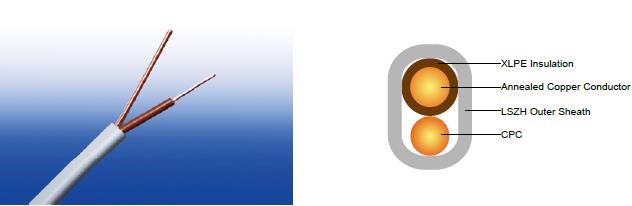
Conductor : Annealed copper conductor, solid according to BS EN 60228 class 1.
Insulation : XLPE type GP8 according to BS 7655-1.3. Crosslinked polyolefin material type EI 5 according to EN
50363-5 can be offered as option.
CPC (Circuit Protective Conductor) : Uninsulated copper conductor.
Outer Sheath : Extruded LSZH type LTS 2 according to BS 7655-6.1.
Outer Sheath Option : UV resistance, hydrocarbon resistance, oil resistance, anti-rodent and anti-termite
properties can be offered as option.
STANDARDS

Basic design to BS 7211:2012
FIRE PERFORMANCE
| Flame Retardance (Single vertical wire or cable test) | IEC 60332-1-2; EN 60332-1-2 |
|---|---|
Reduced Fire Propagation (Vertically-mounted bundled wires & cables test) |
IEC 60332-3-24; EN 60332-3-24 |
Halogen Free |
IEC 60754-1; EN 50267-2-1 |
No Corrosive Gas Emission |
IEC 60754-2; EN 50267-2-2 |
Minimum Smoke Emission |
IEC 61034-2; EN 61034-2 |
CPR Compliance |
Eca |
VOLTAGE RATING
300/500V
COLOUR CODE
Insulation Colour : Brown or blue.
Sheath Colour : White; other colours can be offered upon request.
PHYSICAL AND THERMAL PROPERTIES
Maximum temperature range during operation : 90°C
Maximum short circuit temperature (5 Seconds) : 250°C
Minimum bending radius : 4 x Overall Diameter
CONSTRUCTION PARAMETERS
| Conductor | FTX300 05RZ1-U |
|||||||
|---|---|---|---|---|---|---|---|---|
No. of Cores × Cross-sectional Area |
Conductor Class |
Nominal Insulation Thickness |
Cross- sectional Area of CPC |
Class of CPC |
Nominal Insulation Thickness |
Min. overall Dimensions |
Max. overall Dimensions |
Approx. Weight |
No.×mm² |
|
mm |
mm² |
|
mm |
mm |
mm |
kg/km |
1×1.0 |
1 |
0.70 |
1.0 |
1 |
0.9 |
4.1x5.2 |
5.0x6.3 |
45 |
1×1.5 |
1 |
0.70 |
1.0 |
1 |
0.9 |
4.4x5.4 |
5.3x6.6 |
55 |
Note: The parameters listed above are nominal values as per cable standards. Actual values may vary due to material and manufacturing process variations. For precise specifications or customized requirements, please contact us for further information
ELECTRICAL PROPERTIES
Conductor operating temperature : 90°C
Ambient temperature : 30°C
Current-Carrying Capacities (Amp) according to BS 7671:2008 table 4E1A
| Conductor cross- ectional area | Ref. Method A (enclosed in conduit in thermally insulating wall etc.) |
Ref. Method B (enclosed in conduit on a wall or in trunking etc.) |
Ref. Method C (clipped direct) |
|||
|---|---|---|---|---|---|---|
2 cables, single-phase a.c. or d.c. |
3 or 4 cables, three-phase a.c. |
2 cables, single-phase a.c. or d.c |
3 or 4 cables, three-phase a.c. |
2 cables, single- phase a.c. or d.c. flat and touching |
3 or 4 cables, three-phase a.c. flat and touching or trefoil |
|
1 |
2 |
3 |
4 |
5 |
6 |
7 |
mm² |
A |
A |
A |
A |
A |
A |
1.0 |
14 |
13 |
17 |
15 |
19 |
17.5 |
1.5 |
19 |
17 |
23 |
20 |
25 |
23 |
Voltage Drop (Per Amp Per Meter) according to BS 7671:2008 table 4E1B
| Conductor cross- sectional area | 2 cables d.c. |
2 cables, single-phase a.c. |
3 or 4 cables, three-phase a.c. |
|||||
|---|---|---|---|---|---|---|---|---|
Ref. Methods A&B (enclosed in conduit or trunking) |
Ref. Methods C, F&G (clipped direct, on trays or in free air) |
Ref. Methods A&B (enclosed in conduit or trunking) |
Ref. Methods C, F&G (clipped direct, on trays or in free air) |
|||||
Cables touching, Trefoil |
Cables touching, flat |
Cables spaced*, flat |
||||||
Cables touching |
Cables spaced* |
|||||||
1 |
2 |
3 |
4 |
5 |
6 |
7 |
8 |
9 |
mm² |
mV/A/m |
mV/A/m |
mV/A/m |
mV/A/m |
mV/A/m |
mV/A/m |
mV/A/m |
mV/A/m |
1.0 |
46 |
46 |
46 |
46 |
40 |
40 |
40 |
40 |
1.5 |
31 |
31 |
31 |
31 |
27 |
27 |
27 |
27 |
Note: *Spacings larger than one cable diameter will result in a large voltage drop.