





 |
|||
 |
FIREGUARD Flame Retardant Cables |  |
|
|
|||


 Fire retardant cable(Fireguard)
300/500V PVC Insulated, PVC Sheathed, Twin & Earth Cables (2-3 Cores)
FGD200-E 05VV-U/R (CU/PVC/PVC 300/500V Class 1/2)
BS Code: 6242Y/6243Y
APPLICATION
300/500V PVC Insulated, PVC Sheathed, Twin & Earth Cables (2-3 Cores) are mainly used in power
stations, mass transit underground passenger systems, airports, petrochemical plants, hotels, hospitals, and
high-rise buildings. This product type is TUV approved.
CABLE CONSTRUCTION
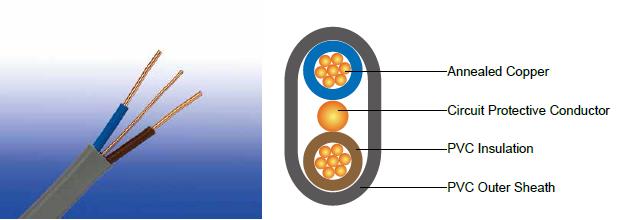
Conductor:Annealed copper conductor,class 1 (1.0mm² to 2.5mm²) or class 2 (4mm² to 35mm²) according to
BS EN 60228.
Insulation:PVC Type TI 1 according to BS EN 50363-3.
Circuit Protective Conductor (CPC):Annealed plain copper (class 1 or 2)
Position of CPC:Centrally placed between cores in same plane (twin); centrally placed between black and grey
cores in same plane(3-core).
Outer Sheath:PVC Type 6 according to BS 7655-4.2.
Outer Sheath Option:UV resistance,hydrocarbon resistance,oil resistance,anti rodent and anti termite
properties can be offered as option. Compliance to fire performance standard (IEC 60332-1,IEC 60332-3,UL
1581,UL 1666 etc) depends on the oxygen index of the PVC compound and the overall cable design. LSPVC can
also be provided upon request.
STANDARDS
Basic design to BS 6004:2012
FIRE PERFORMANCE
| Flame Retardance (Single Vertical Wire Test) | EN 60332-1-2 |
|---|
VOLTAGE RATING
300/500V
COLOUR CODE
Insulation Colour :
Twin : brown and blue, alternatively, for 2 x 1.0 and 2 x 1.5 cables, brown and brown;
3-core : brown, black (centre core), and grey
Sheath Colour : Grey, other colours can be offered upon request.
PHYSICAL AND THERMAL PROPERTIES
| Maximum temperature range during operation (PVC) | 70°C |
|---|---|
Maximum short circuit temperature (5 Seconds) |
160°C |
Minimum bending radius |
8 x overall diameter |
CONSTRUCTION PARAMETERS
| Conductor | FGD200-E 05VV-U/R |
||||||
|---|---|---|---|---|---|---|---|
No. of Cores x Cross Section |
Class of Conductor |
Nominal Insulation Thickness |
Cross-Section Area of CPC |
Class of CPC |
Nominal Sheath Thickness |
Maximum Overall Diameter |
Approx. Weight |
No.xmm² |
|
mm |
mm² |
|
mm |
mm |
kg/km |
2x1.0 |
1 |
0.6 |
1.0 |
1 |
0.9 |
4.8x8.7 |
68 |
2x1.5 |
1 |
0.7 |
1.0 |
1 |
0.9 |
5.3x9.7 |
85 |
2x2.5 |
1 |
0.8 |
1.5 |
1 |
1.0 |
6.2x11.7 |
120 |
2x4.0 |
2 |
0.8 |
1.5 |
1 |
1.0 |
6.9x13.1 |
175 |
2x6.0 |
2 |
0.8 |
2.5 |
1 |
1.1 |
7.8x15.0 |
240 |
2x10 |
2 |
1.0 |
4.0 |
2 |
1.2 |
9.5x18.9 |
390 |
2x16 |
2 |
1.0 |
6.0 |
2 |
1.3 |
10.8x21.9 |
560 |
3x1.0 |
1 |
0.6 |
1.0 |
1 |
0.9 |
4.8x11.4 |
91 |
3x1.5 |
1 |
0.7 |
1.0 |
1 |
0.9 |
5.3x12.9 |
115 |
3x2.5 |
1 |
0.8 |
1.5 |
1 |
1.0 |
6.2x15.3 |
170 |
3x4.0 |
2 |
0.8 |
1.5 |
1 |
1.1 |
7.1x17.9 |
250 |
3x6.0 |
2 |
0.8 |
2.5 |
1 |
1.1 |
7.8x20.2 |
340 |
3x10 |
2 |
1.0 |
4.0 |
2 |
1.2 |
9.5x25.7 |
540 |
3x16 |
2 |
1.0 |
6.0 |
2 |
1.3 |
10.8x29.7 |
790 |
Note: The parameters listed above are nominal values as per cable standards. Actual values may vary due to material and manufacturing process variations. For precise specifications or customized requirements, please contact us for further information
ELECTRICAL PROPERTIES
| Conductor Operating Temperature | 70°C |
|---|---|
Ambient Temperature |
30°C |
Current-Carrying Capacities (Amp) and Voltage Drop (Per Amp Per Meter) according to BS7671:2008 table 4D5
Conductor cross-sectional area |
Reference Method 100# (above a plasterboard ceiling covered by thermal insulation not exceeding 100 mm in thickness) |
Reference Method 101# (above a plasterboard ceiling covered by thermal insulation exceeding 100 mm in thickness) |
Reference Method 102# (in a stud wall with thermal insulation with cable touching the inner wall surface) |
Reference Method 103# (in a stud wall with thermal insulation with cable not touching the inner wall surface) |
Reference Method C* (clipped direct) |
Reference Method A* (enclosed in conduit in an insulated wall) |
Voltage Drop (per ampere per meter) |
|---|---|---|---|---|---|---|---|
1 |
2 |
3 |
4 |
5 |
6 |
7 |
8 |
mm² |
A |
A |
A |
A |
A |
A |
mV/A/m |
1.0 |
13 |
10.5 |
13 |
8.0 |
16 |
11.5 |
44 |
1.5 |
16 |
13 |
16 |
10 |
20 |
14.5 |
29 |
2.5 |
21 |
17 |
21 |
13.5 |
27 |
20 |
18 |
4.0 |
27 |
22 |
27 |
17.5 |
37 |
26 |
11 |
6.0 |
34 |
27 |
35 |
23.5 |
47 |
32 |
7.3 |
10 |
45 |
36 |
47 |
32 |
64 |
44 |
4.4 |
16 |
57 |
46 |
63 |
42.5 |
85 |
57 |
2.8 |
A* For full installation method refer to Table 4A2 (BS 7671-2008) Installation Method 2 but for flat twin and earth cable
C* For full installation method refer to Table 4A2 (BS 7671-2008) Installation Method 20 but for flat twin and earth cable
100# For full installation method refer to Table 4A2 (BS 7671-2008) Installation Method 100
102# For full installation method refer to Table 4A2 (BS 7671-2008) Installation Method 102
103# For full installation method refer to Table 4A2 (BS 7671-2008) Installation Method 103
Wherever practicable, a cable is to be fixed in a position such that it will not be covered with thermal insulation.
Regulation 523.7, BS 5803-5 Appendix C: Avoidance of overheating of electric cables, Building Regulations Approved document B and Thermal insulation: avoiding risks, BR 262, BRE, 2001 refer.